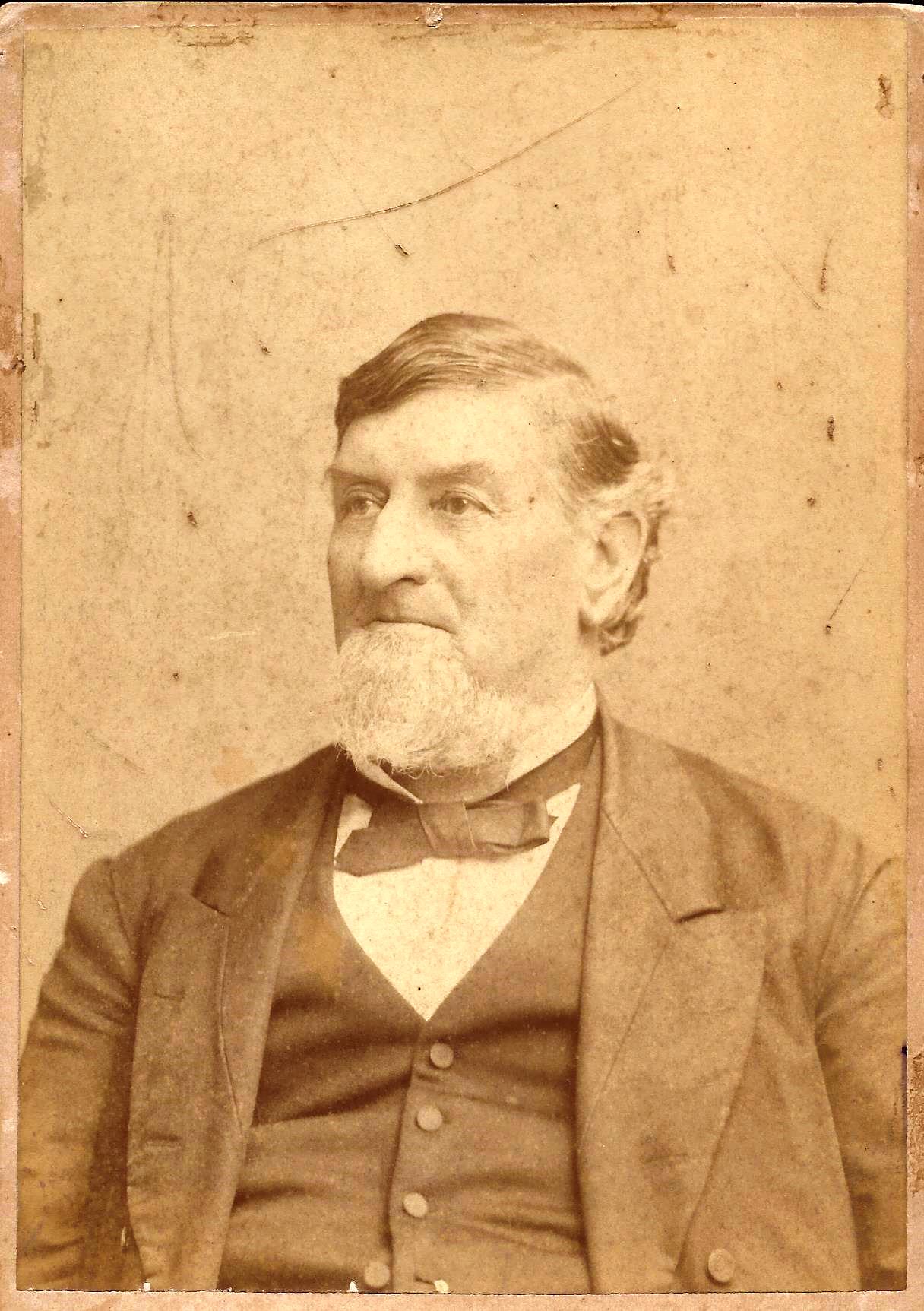

When William Basil Wood died in Florence on April 3, 1891, the Florence Times struggled to summarize the life of a man who had been involved in nearly every major phase of the city’s development.
The newspaper wrote:
“A full and faithful biography of him would, in large measure, constitute the history of Florence for the past fifty years.”
It was hardly an exaggeration.
During nearly half a century in Florence, Wood served as a lawyer and judge, commanded soldiers during the Civil War, operated steamboats, promoted railroads, organized industries, helped develop the city’s iron business, and worked to preserve the college that eventually became the University of North Alabama.
By the end of his life, his contemporaries were calling him “The Father of Florence.”
A Young Lawyer Comes to Florence
William Basil Wood was born in Nashville, Tennessee, on October 31, 1820, the son of Alexander H. Wood and Mary E. Evans Wood.
He attended LaGrange College in Franklin County, Alabama, and studied law under Judge Coleman, who later served on the Alabama Supreme Court.
Wood was admitted to the bar at Florence in the early 1840s and began practicing law there. On April 21, 1843, he married Sarah Briscoe Leftwich, with whom he would spend the remainder of his life.
His rise in local affairs came quickly. In 1844, while still in his early twenties, Wood was elected judge of Lauderdale County. It was the beginning of a public career that would span nearly fifty years.
Wood later served as a circuit court judge as well. Remarkably, he was elected to that office in 1862 while serving in the Confederate Army and was elected again after the war, remaining on the bench for much of the period until 1880, aside from the interruption of Reconstruction.
Colonel of the 16th Alabama
When the Civil War began, Wood helped raise and organize the 16th Alabama Infantry Regiment at Courtland and was elected its colonel in August 1861. He commanded the regiment for nearly two years.
Wood participated in the fighting at Fishing Creek in Kentucky, where Confederate General Felix Zollicoffer was killed, and was involved in campaigns at Triune and Murfreesboro. His regiment also fought at Shiloh and in other battles of the Army of Tennessee.
In 1863, Confederate President Jefferson Davis transferred Wood to the Army of Northern Virginia and appointed him president judge of the military court of the First Army Corps, associated with General James Longstreet’s command. He remained in that position until the end of the war.
After four years of conflict, Wood returned to Florence and resumed the work that would define the rest of his life: building the city.
Wood’s Steamboats
Wood had business interests even before the war, but transportation became particularly important to him afterward.
He became heavily involved in the steamboat trade and eventually owned or controlled a line of vessels operating on the Tennessee, Ohio and Mississippi rivers.
His company built the Rapidan in 1868 and the Florence Lee in 1870. Wood was also associated with the James R., Sallie Wood, and William Dickinson steamboats. He remained in the steamboat business until about 1876.
For Florence, this mattered enormously. Before modern highways and extensive railroad connections, the Tennessee River was one of the region’s principal commercial highways. Steamboats carried people, agricultural products, manufactured goods and supplies between the Shoals and markets far beyond North Alabama.
But Wood was already looking toward Florence’s next transportation revolution.
Railroads and the New Florence
By the 1880s, Wood had turned much of his attention toward railroads and industrial development. He helped organize several railroad ventures, including the Indiana, Alabama & Texas Railway, the Birmingham & Tennessee Railroad, and the Alabama & Tennessee Railroad.
Contemporary accounts portray Wood as almost relentlessly interested in public improvements. Long before Florence’s great industrial boom of the late 1880s, he had been advocating railroads, factories and other enterprises that he believed could transform the city.
One newspaper remembered him as a man of “unconquerable perseverance and boundless energy” who seemed naturally to assume leadership whenever Florence organized around some new public enterprise. That drive eventually led to one of his most important undertakings.
The Florence Land, Mining and Manufacturing Company
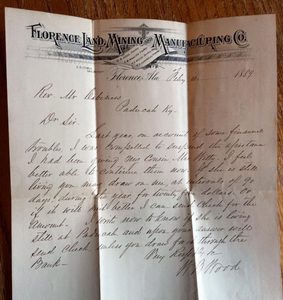
On November 29, 1886, Wood became one of the organizers of the Florence Land, Mining and Manufacturing Company and was elected its president. The company became a major force behind Florence’s industrial development during the boom years of the late 1880s.
Its purpose was larger than any single factory. Wood and his associates promoted land development, mineral resources, manufacturing, rail transportation and other improvements designed to attract investment and industry to Florence.
He also became involved with the Railroad & Improvement Company and several other ventures. A contemporary biography from 1888 gives some idea of the extraordinary number of projects occupying his attention. At the time, Wood held leadership positions with companies involved in land development, iron production, chemicals and multiple railroad projects.
He was nearly seventy years old.
The W. B. Wood Furnace
One of Wood’s most visible industrial ventures was iron production. Together with Congressman William C. Sherrod and other investors, Wood organized the W. B. Wood Furnace Company in 1887–88. The company constructed a blast furnace capable of producing approximately 150 tons of iron.
To manage the operation, Wood hired experienced furnaceman John M. Norton, who had worked in the iron industry in Alabama, Kentucky, Ohio, Illinois and West Virginia. Florence was entering into direct competition with the rapidly developing industrial city of Sheffield across the Tennessee River.
Another blast furnace was constructed in Florence in 1887 by the North Alabama Furnace, Foundry and Land Company, a concern reportedly capitalized at $2 million and backed by some of the wealthiest investors in the South.
The Story of Coal and Iron in Alabama later described the rivalry vividly: Florence was soon “locking horns with Sheffield.” Wood was one of the principal figures determined that Florence would compete.
The College He Helped Save
For all Wood’s work with railroads, steamships and factories, one of his most lasting contributions had nothing to do with heavy industry. It involved education.
Wood was deeply connected with the institution then known as Florence Wesleyan University.
He helped raise subscriptions for the school, contributed money himself, and served for years as president of its Board of Trustees. Contemporary accounts credited him with playing an important role in establishing and sustaining the institution in Florence.
After the Civil War, the university faced a severe financial crisis. Its endowment had been exhausted. Wood helped arrange for the institution to be transferred to the State of Alabama, where it became the State Normal School at Florence, devoted largely to training teachers.
The Achievement He Valued Most
Wood’s public life extended beyond business and politics. He was deeply involved with the Methodist Church in Florence. In 1844, he organized a Methodist Sunday school two years before he formally joined the church himself. He subsequently served as its superintendent and teacher while also holding positions as church steward and trustee.
Late in life, after decades spent as a judge, soldier, businessman and civic promoter, Wood reportedly said that his work with that Sunday school was the accomplishment he regarded as “the proudest achievement of his life.” That small detail reveals something that lists of companies and offices cannot.
For a man associated with blast furnaces, steamboats and railroads, the achievement he apparently valued most was teaching children on Sunday.
The Death of the “Father of Florence”
William Basil Wood died suddenly at his Florence home on the evening of April 3, 1891.
According to the Florence Times, he had just finished supper and was sitting before the fire talking with his nephew, Sam Rice. He appeared to be in his usual good spirits when his heart suddenly stopped.
He fell forward and died before he could be placed in bed. The newspaper described the loss in striking terms:
“Florence loses a citizen whose loss cannot be repaired.”
His funeral was held the following Sunday at the Methodist Church. The auditorium was filled with relatives and friends, and the newspaper reported that the procession to Florence Cemetery was among the largest ever seen accompanying a citizen to burial there.
Wood was laid to rest in Florence Cemetery. His wife Sarah joined him there after her death in 1898.
A Life Entwined With Florence
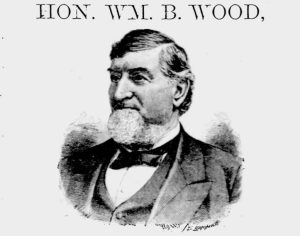
William Basil Wood arrived in Florence as a young lawyer when the city was still developing around its river trade. Over the next half century, he became involved in almost every force that reshaped it.
- He practiced law and served on the bench.
- He raised and commanded a regiment.
- He operated steamboats.
- He promoted railroads.
- He organized development companies.
- He built an iron furnace.
- He supported his church.
- And he helped preserve Florence’s college.
The Florence Times remembered him as a man who had helped originate and organize many of the enterprises responsible for the city’s growth.
More than a century later, his name remains on the Florence landscape in Wood Avenue.
That is why his contemporaries gave William Basil Wood a title few men could reasonably claim: “The Father of Florence.”