
About five miles west of Florence, along Gunwaleford Road, stood the John Peters Plantation, a sprawling agricultural estate covering approximately 6,620 acres. By 1860, it had become one of the largest slaveholding operations in Lauderdale County, with 313 enslaved people recorded under Peters’s name.
The plantation dates to Alabama’s earliest settlement years. Historical records indicate that Peters purchased land in the area as early as 1816. Born in Greensville County, Virginia, he came to Lauderdale County with his mother, Temperance Peters. The plantation house was reportedly constructed in the early 1830s.
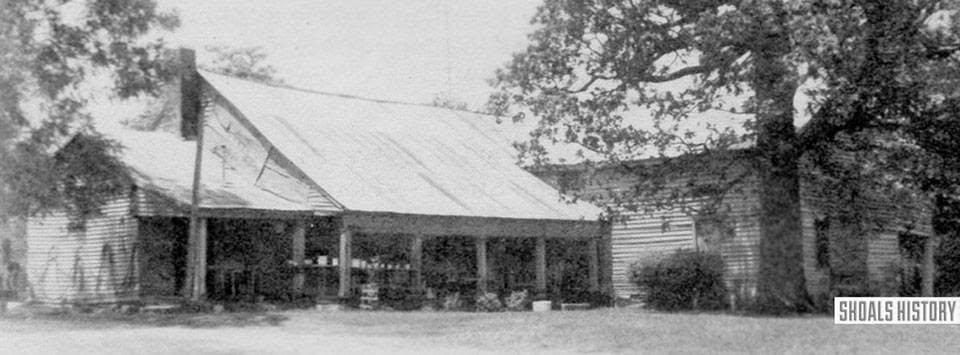
Unlike the elaborate mansions associated with wealthy Southern planters, Peters lived in a relatively modest wooden house. The structure featured a long front porch, weatherboard siding, and a prominent chimney, as seen in surviving photographs.
Despite its unassuming appearance, the plantation was an enormous agricultural operation. In 1859, Peters reportedly produced 681 bales of cotton, making him Lauderdale County’s largest cotton producer. Records also attribute approximately 25,000 bushels of corn and 11,000 bushels of oats to the plantation, along with wheat, potatoes, peas, beans, wool, butter, and other goods.
The estate maintained substantial livestock holdings, including cattle, hogs, and approximately 150 sheep. This diversified production supplied food and other necessities for the plantation’s workforce and its animals, while cotton remained its principal commercial crop.
The plantation’s productivity depended entirely upon enslaved labor. The 1860 federal census recorded 313 enslaved people under John Peters’s name, distributed across five census pages. His estate, according to old newspaper clippings, contained 98 cabins used to house enslaved people.
A few names survive in earlier family records. In 1849, Temperance Peters’s estate identified enslaved individuals named Ben, Patty, Fill, Plunk, Jenny, Julia, Andrew, Amanda, Charlotte, another Ben, Margaret, Eliza, and Eliza’s son Anthony. These fragments provide a rare glimpse of the individuals behind the plantation’s otherwise anonymous census figures.
The Civil War brought an end to the institution upon which Peters’s agricultural empire had been built. On March 27, 1867, Peters transferred his Lauderdale County property over to his niece, Elizabeth T. Swoope, under an agreement requiring her family to assume his debts and provide him with $2,000 annually for life.
John Peters died in 1869. The property’s financial affairs continued to generate litigation for decades afterward, eventually appearing in a Texas Supreme Court decision in 1899.
The old plantation house survived for another century before being demolished in the mid-1970s. Photographs preserved by Florence Arts and Museums document the structure shortly before its disappearance.