
On June 21, 1838, a Cherokee man known as Chicken was killed after jumping from a moving railroad car about a mile outside Tuscumbia, Alabama. He was among hundreds of Cherokee being transported west during the forced removal now remembered as the Trail of Tears.
His death was recorded by the Army officer accompanying the group and reported in a local newspaper. Four years later, a claim filed by a Cherokee woman may have preserved his original name: Tsitaga.
The Trail of Tears Through Tuscumbia
During the 1830s, the federal government forced thousands of Native Americans from their homelands in the southeastern United States to Indian Territory, in present-day Oklahoma. Among them were the Cherokee, whose removal intensified in 1838.
For several groups traveling along the Tennessee River, the dangerous shoals near present-day Muscle Shoals presented a major obstacle. To bypass this stretch, travelers transferred to the Tuscumbia, Courtland & Decatur Railroad, one of Alabama’s earliest railroads.
The railroad connected Decatur with Tuscumbia, where passengers could continue toward Tuscumbia Landing on the Tennessee River. From there, the Cherokee were placed aboard boats to resume their journey west.
A Fatal Accident Near Tuscumbia
On June 21, 1838, approximately 975 Cherokee under the supervision of U.S. Army Lieutenant Robert H. K. Whiteley reached Decatur and boarded two trains bound for Tuscumbia.
According to Whiteley’s account, a Cherokee man identified as Chicken was riding on the second train when he lost his hat. Attempting to retrieve it, he jumped from the moving railroad car and was killed. The accident occurred approximately one mile from Tuscumbia.
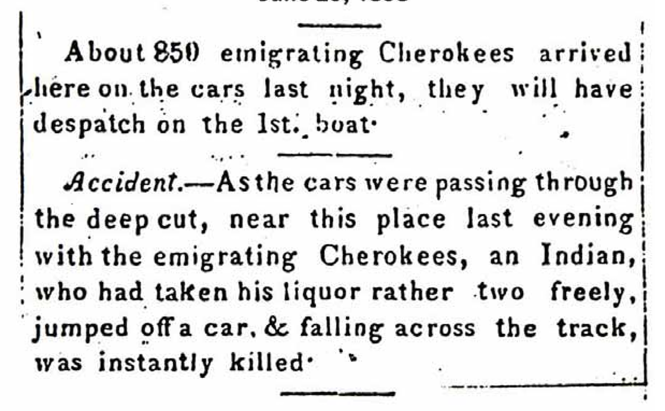
A newspaper account dated June 23, 1838, also described the accident but offered a somewhat different explanation. It reported that the man had consumed liquor before jumping from a railroad car as the train passed through a deep cut.
Although the circumstances differ between the two accounts, both establish that a Cherokee man died on the railroad during the June 1838 removal.
A Name Preserved by His Sister
For more than a century, the victim might have remained known only by the English name Chicken. However, another historical record provides a possible identification.
In 1842, a Cherokee woman named Ailsey filed a claim in the Flint District of the Cherokee Nation. According to research published in the National Park Service’s Trail of Tears National Historic Trail proceedings, she stated that her brother, Tsitaga, also known as Chicken, had been killed by a railroad car during the journey west.
Because researchers found no other comparable railroad fatality reported during the removal, they concluded that Tsitaga was probably the man described in Whiteley’s account. The identification has not been established beyond doubt, but it offers a rare personal connection to an otherwise nearly forgotten tragedy.
Remembering Tsitaga
Whiteley’s detachment continued west after the accident, encountering additional transportation difficulties, illness, and delays. Of the approximately 975 Cherokee who began the journey, only 602 were recorded as present when the group reached the Flint settlement.
Little else is currently known about Tsitaga. His age, birthplace, and burial location have not been established, and no known portrait of him survives. His death, however, remains documented in three separate historical references: an Army officer’s report, a contemporary newspaper account, and a later family claim.
Bibliography
Primary sources
- Whiteley, Robert H. K. Journal of the 1838 Cherokee Removal Detachment, June 1838. National Archives. Excerpts reproduced in National Park Service transportation and Trail of Tears historical studies.
- Unidentified newspaper, June 23, 1838. Report concerning the arrival of Cherokee emigrants and a fatal railroad accident near Tuscumbia. Reproduced in North Alabama’s Tuscumbia, Courtland and Decatur Railroad and Its Role in Cherokee Removal, Figure 3.67, p. 194. Original clipping courtesy of the Tuscumbia Depot Museum.
- Ailsey. Spoliation claim, Flint District, Cherokee Nation, 1842. Described in Trail of Tears National Historic Trail conference proceedings, p. 43, footnote 3.
Historical research and publications
- National Park Service and Middle Tennessee State University. Rivers, Rails & Roads: Transportation During the Cherokee Removal, 1837–1839. November 2020, pp. 11–16.
- National Park Service. “The Tuscumbia, Courtland & Decatur Railroad: Transportation During the Cherokee Removal, 1837–1839.” Trail of Tears National Historic Trail.
- National Park Service. Trail of Tears National Historic Trail conference proceedings, p. 43.
- National Park Service. North Alabama’s Tuscumbia, Courtland and Decatur Railroad and Its Role in Cherokee Removal. Historical research report, Figure 3.67, p. 194.
- National Park Service. “Tuscumbia Landing.” Trail of Tears National Historic Trail.