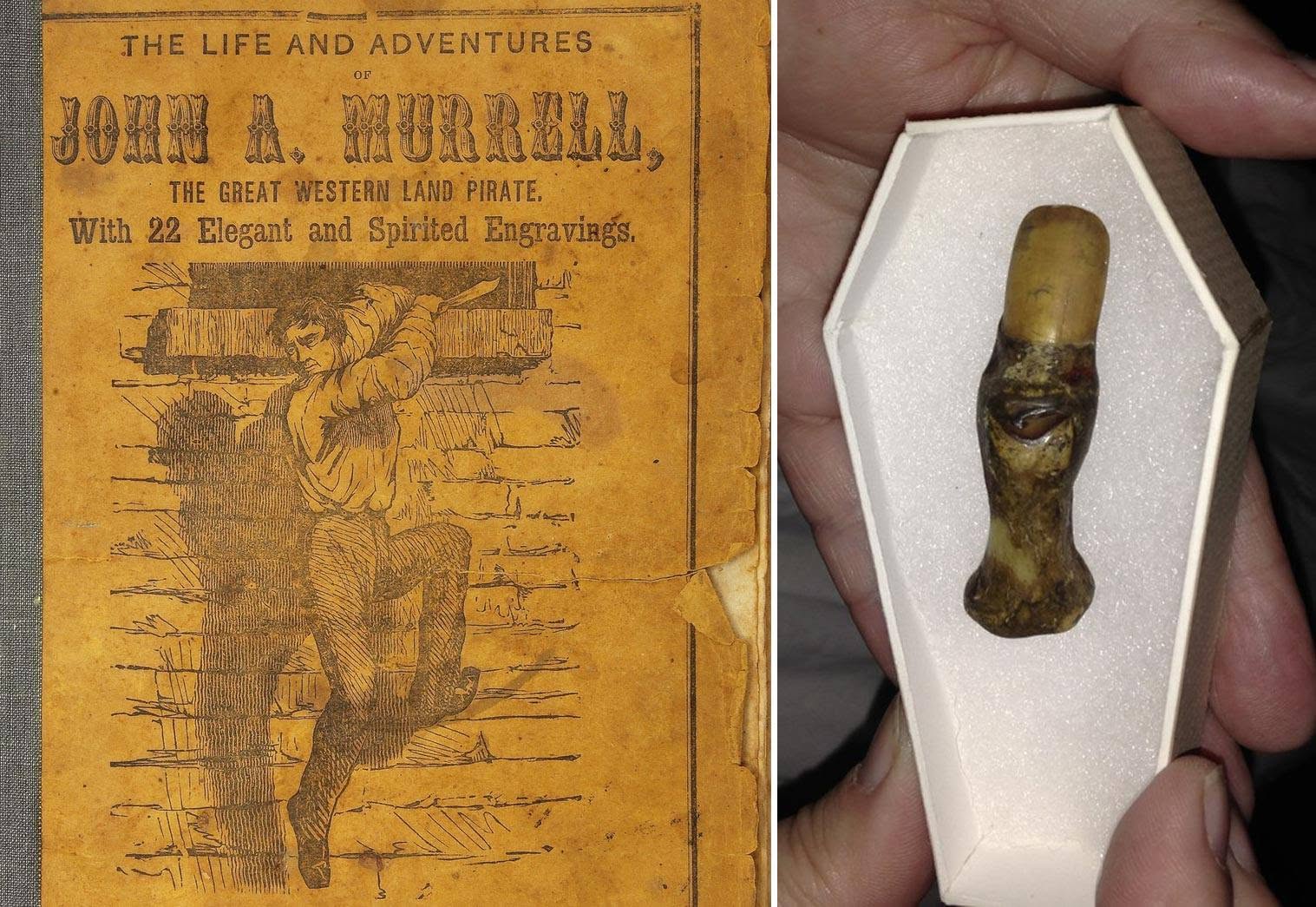

The story of John A. Murrell is one of those pieces of Southern history where fact, folklore, and outright sensationalism have become so tangled together that separating one from another is nearly impossible.
Known in later accounts as the “Great Western Land Pirate,” Murrell became one of the most notorious outlaws of the early 19th-century South. He was accused of horse theft, robbery, counterfeiting, slave stealing, and operating an enormous secret criminal organization known as the Mystic Clan. Part of his story runs directly through Florence, Alabama.
John Murrell Comes to Florence
Murrell traveled throughout Tennessee, Mississippi, Louisiana, Arkansas, and Alabama during the 1820s and 1830s. The Tennessee River made the Shoals an important transportation corridor, and Florence was a growing town along that route.
According to local accounts, Murrell operated in and around Florence and Cypress Creek, where his criminal career eventually caught up with him.
One of the most persistent local stories says Murrell was captured near Cypress Creek with the assistance of an enslaved man. The episode became significant enough in local history that Murrell’s connection to the area was later commemorated with a historical marker.
His arrest ultimately led to his conviction in Tennessee. But getting arrested was only one chapter in a story that had already grown larger than the man himself.
The Mysterious “Mystic Clan”
Murrell was said to have organized a sprawling network of criminals known as the Mystic Clan. Stories about the organization described its members as robbers, counterfeiters, horse thieves, slave stealers, and murderers operating throughout the Mississippi and Tennessee valleys. Some accounts went considerably further.
Murrell was even accused of dreaming of an outlaw empire with New Orleans as its capital and himself as its leader. His supposed organization was portrayed as a secret society whose members communicated through signs and passwords while preparing for robberies, slave thefts, and even a widespread uprising.
It makes for a remarkable story. The problem is that much of it may have been just that — a story.
Many of the most sensational claims about Murrell came from publications produced during and after his lifetime. Newspapers and popular writers repeated and embellished the stories until the historical John Murrell became almost inseparable from the legendary one.
The Darkest Stories About Murrell
Among the most disturbing accusations involved Murrell’s activities as a slave stealer and trader.
According to accounts circulated about him, Murrell sometimes approached enslaved people with an offer: he would help them escape, sell them farther downriver, arrange for them to escape again, and repeat the scheme several times before eventually helping them reach freedom in the North.
Murrell supposedly collected the money each time the same person was sold. The story becomes much darker from there.
Later accounts claimed that once the scheme became too dangerous, Murrell and his associates murdered some of their victims rather than risk discovery. Particularly gruesome versions claimed bodies were cut open, weighted with stones, and dumped into rivers and creeks.
These stories became central to the Murrell legend, but they should be treated carefully. Like many claims surrounding the Mystic Clan, determining exactly which crimes Murrell personally committed and which were later exaggerations is difficult.
What is certain is that the slave trade created an environment in which kidnapping and the illegal sale of free Black people could occur. For criminals operating along the rivers and roads of the South, human beings could be treated as stolen property and sold for profit.
That reality was horrifying enough without the legends.
Prison, Death, and a Missing Skull
Murrell was finally convicted in Tennessee in 1834 and sentenced to prison. He was eventually released, but he did not live long afterward. Murrell died in 1844, reportedly from complications related to tuberculosis. Even death, however, did not put an end to his strange story.
Murrell’s grave was reportedly disturbed after his burial, and portions of his body were taken. His skull disappeared and has never been conclusively recovered.
Even stranger, an object identified as one of John Murrell’s thumbs eventually became part of the collection of the Tennessee State Museum. It is a suitably bizarre ending for a man whose life had already become legend.
Where the Man Ends and the Legend Begins
There is no question that John A. Murrell was a criminal. He stole horses, participated in the illegal slave trade, and spent years in prison. Beyond those basic facts, things become much murkier.
The enormous Mystic Clan, the planned criminal empire, elaborate murder schemes, secret codes, and many other details attributed to Murrell were repeated so often that they became accepted as part of his biography. Some may contain elements of truth. Others were almost certainly exaggerated, embellished, or invented entirely.
That is part of what makes Murrell’s story so interesting.
Nearly two centuries later, the outlaw who once passed through Florence and Cypress Creek remains hidden behind the legend created around him. The real John A. Murrell was dangerous enough.
The version that survived in Southern folklore became something much larger.
- Mark Twain talks about John Murrell in his book “Life on the Mississippi.” In “Tom Sawyer,” Tom and Huck are searching for Murrell’s lost treasure.
- In 1940, Humphrey Bogart played John Murrell in a movie called “Virginia City.”
- A fictionalized John Murrell appeared in 1950s TV shows such as “The Adventures of Jim Bowie” and “Riverboat.”
- Murrell was the central figure in the 1960 movie “Natchez Trace”.