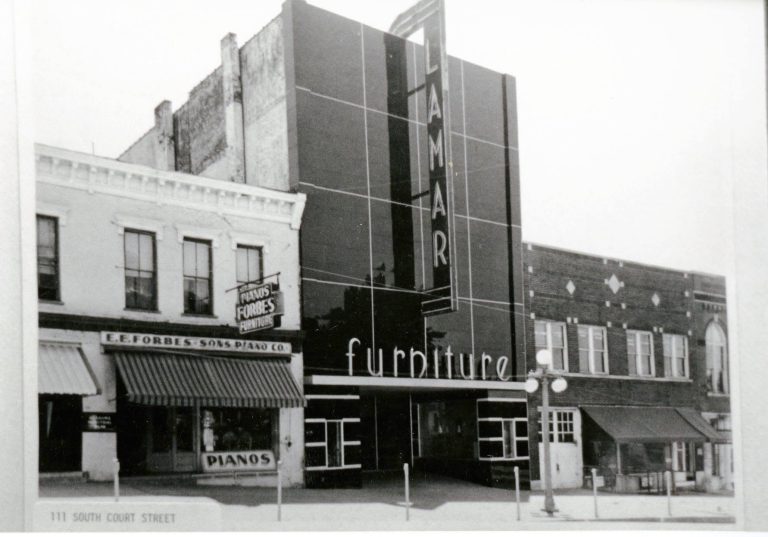

If you had walked down Court Street in Florence during the second half of the 1800s, you probably wouldn’t have needed an address to find the Stafford Block, also called Stafford’s Corner. People simply knew where it was. Today, you’ll know it as the corner of Court and Mobile streets where the Southall building currently sits.
Newspaper advertisements directed customers to businesses “two doors South of Stafford’s Corner.” A bootmaker told customers to walk up Court Street until they reached Stafford’s Corner and look for a giant boot hanging from a pole. Runaway animals were reported as making it as far as Stafford’s Corner before causing trouble. For decades, the name served as both a business address and a downtown landmark.
The Stafford Block stood along Court Street, with references also placing businesses in the block on Mobile Street. By January 1858, Stafford’s Corner was already established enough that other businesses used it when giving directions.
The Stafford Name
Several members of the Stafford family appear in records connected with early Florence, including Samuel C. Stafford, Caleb A. Stafford, Abel C. Stafford and James Stafford.
S.C. Stafford appears particularly early. In October 1858, he was identified as an alderman, suggesting that the Stafford name was connected not only with commerce but also with civic affairs.
By December 1859, an advertisement for a new confectionery operated by G.W. Lane described its location simply as “three doors South of Staffords Corner.” Two months earlier, a fashionable boot and shoe maker had advertised his shop as being “one door South of Stafford’s Corner.”
There was also at least one darker incident associated with the property. On November 13, 1861, a shooting was reported to have occurred inside Mr. S.C. Stafford’s store.
Reid & Stafford
By the early 1870s, one of the best-known businesses at the corner appears to have been Reid & Stafford. An 1872 advertisement paints a surprisingly vivid picture of the building and the businesses operating around it.
Customers looking for boots and shoes were instructed to walk up Court Street until they reached Stafford’s Corner. There they would see a “monster boot hanging to a pole.” Upstairs was boot and shoe maker J.R. Heale. If you wanted fresh beef or mutton instead, you could head into the cellar, where Jacobs could supply it. And if groceries were what you needed, you could walk into Reid & Stafford.
In other words, Stafford’s Corner wasn’t just one store. At various times it was essentially a small collection of businesses stacked above, below and beside one another.
J.R. Heale advertised his boot and shoe shop in April 1872 as being in the upstairs front room above Reid & Stafford. The following month, G. Jacobs & Bros. advertised fresh beef and mutton at Stafford’s Corner.
Even professional offices could be found there. In February 1873, Dr. J.D. Yeiser announced that during the day he could be found in his office in Stafford’s building, lower story, Room No. 24.
Unfortunately, the partnership of Reid & Stafford did not last. On April 23, 1873, John S. Reid and James Stafford mutually dissolved their general merchandise business. The corner, however, kept the Stafford name.
A Little Bit of Everything
Over the following two decades, the Stafford Block became home to an almost comical variety of Florence businesses.
Professor Theo. Colere advertised a business room over S.C. Stafford’s store in 1871, where he taught French, Italian and German, along with drawing and oil painting.
In 1874, H.D. Smith operated one door below Stafford’s store, selling bacon, lard and flour.
By January 1881, Ellis & Blair had opened what they advertised as a “first class saloon” in the Stafford Block, one door from the corner. Their establishment also included a billiard hall and ten-pin alley.
In 1889, Meadow & Sharp operated in the Stafford Block on Mobile Street, selling staple and fancy groceries.
And in 1890, Harrison Baugh was cutting hair there. His advertisement promised a nice shave, haircut and shampoo and claimed he could fix a customer up “as nice as a bouquet of flowers.”
It’s hard to ask much more from one downtown block. You could buy groceries, get a steak, have boots made, learn Italian, visit a doctor, get a haircut, play ten-pins and stop by the saloon without wandering very far at all.
The Newspapers Move In
The Stafford Block also became an important home for Florence newspapers.
In September 1890, The Herald announced that it would move its editorial, press and job departments into “new and commodious quarters” in the Stafford Block on Court Street. The rooms were being remodeled specifically for the newspaper. The Herald explained that its growing business had created an “imperative need” for additional workspace.
The newspaper was apparently not exaggerating about the difficulty of moving a printing operation in 1890. On October 25, it apologized for missing its Wednesday issue because the move had been so consuming.
A few years later, the Florence Gazette also called the Stafford Block home. In February 1894, the Gazette announced that its office had moved upstairs over the dry-goods store of Jones & Smith in the Stafford Block. An advertisement later that year listed the Florence Gazette Office simply as:
Court Street
Stafford Block
Florence, Alabama
Again, everybody apparently knew where that meant.
Stafford’s Corner Changes Hands
By the 1890s, ownership of the property began changing.
David Jones owned the Stafford Corner building by January 1893, when he was reported to be constructing an addition to the rear of his saloon. The addition extended nearly across the existing pavement and brought the building to a line established by the city engineer.
In November of that year, it was reported that Jones had sold his “Stafford Corner” building to James McPeters.
Another account, apparently from around this period, reported that Jones had sold his saloon building (the Stafford Corner) to Frank M. Perry. Unfortunately for Jones, the same report concerned something entirely different: he had lost between $1,600 and $1,700 and did not know whether the money had been taken from his coat pocket in the saloon or simply lost.
The ownership history became clearer by January 31, 1895. At that time, the Stafford Block on Court Street was described as the property of Mrs. B.A. Saunders, and was purchased by F.M. Perry for $3,500. Perry soon began making substantial improvements.
Rebuilding the Stafford Block
The Stafford Block of the late 1890s was not necessarily identical to the building people had known decades earlier.
In October 1895, brickwork was underway on the rear portion of the block under the direction of Mr. McGerkin. Another report described Perry as having a large workforce constructing brick additions to two Court Street stores occupied by Smith & Jones.
By November, Perry was making “extensive repairs” to the rear of the buildings, adding brick extensions. One storeroom was to extend nearly all the way to the alley, while the fronts of two buildings were also being remodeled.
The work was substantial enough that by December the newspaper reported that the Smith & Jones store in the Stafford Block had been “raised and remodeled.” The brick storerooms had also been extended all the way toward the rear alley.
Construction continued to affect tenants into 1896. The Whitehouse temporarily moved two doors north into the Stafford Block while its regular building was being repaired.
Later that year, Mrs. S.E. Green moved her millinery store from Tennessee Street into the Stafford Block, occupying the third room from the corner. By April 1897, Mrs. Alice Carlson was advertising a “Big Cut In Millinery” from her shop in the Stafford Block on Court Street.
The old corner was still very much alive.
Who Built It?
One small clue about the actual construction of the Stafford Block appeared decades later.
In March 1900, a newspaper story recalled a man named Leath, described as a brick mason who also owned a small farm along a factory stream. The article noted that Leath had been a prominent man and had “assisted in the building of what is known as the Stafford Block in your city.”
Unfortunately, the clipping does not tell us exactly when that construction took place or whether it refers to the original Stafford building or some later portion of the block. What we can say is that the Stafford name was associated with the corner by at least January 1858, and the property underwent considerable expansion and remodeling during the 1890s.
A Florence Landmark
Perhaps the best evidence of Stafford’s Corner’s importance is found in stories that had nothing to do with the Stafford family or the businesses in the building.
In one newspaper account, a mule became frightened during a thunderstorm, jerked loose from a wagon and ran up Court Street. Where did the newspaper say it went?
“To Stafford’s Corner.”
There the mule collided with another team, which also took fright, dashed away and eventually became hung up on a telephone post near the Surprise Store, knocking down a gas-light lantern in the process.
Thankfully, the newspaper reported that not much damage was done. But the story tells us something useful. The writer didn’t need to explain Stafford’s Corner. Readers knew it.
That same familiarity appears again and again in advertisements stretching across decades. Businesses located themselves in relation to it. Merchants used it to give directions. Newspapers put its name in their addresses.
Even after the Stafford businesses themselves had changed, the name remained.