Long before downtown Florence became the center of business activity that we know today, much of the commerce of the young town took place below the bluff, along the Tennessee River. And it wasn’t limited to the Florence side.
During the first half of the 19th century, busy commercial districts developed on both banks of the Tennessee River. The landing below Florence was known as North Port, while the settlement directly across the river was called South Port and, increasingly, South Florence.
Warehouses, commission houses, stores, ferries, steamboats and eventually railroads crowded this relatively small stretch of river. For several decades, it was one of the most important commercial places in the Shoals.
Commerce at the Foot of the Muscle Shoals
The dangerous Muscle Shoals lay immediately upstream. Before the river was extensively improved, the shoals were a major obstacle to navigation. Florence therefore developed near the head of reliable steamboat navigation on the lower Tennessee River. Goods moving into North Alabama could come upriver by boat, be unloaded at Florence, and continue overland. Agricultural products—especially cotton—could move the opposite direction toward larger markets.
The settlement that became South Port apparently existed even before Florence was formally established. A Muscle Shoals National Heritage Area chronology dates the South Port settlement to 1813 and the Florence ferry connection to about 1817–1818.
When the Cypress Land Company sold lots for the new town of Florence in July 1818, the ferry landing was already valuable real estate. The ferry lot reportedly sold for $10,000, an extraordinary price compared with many of the other town lots.
The ferry connected the new community on the north bank with South Port on the opposite shore and helped create what was effectively a single commercial zone divided by the Tennessee River.
North Port: Florence’s First Business District
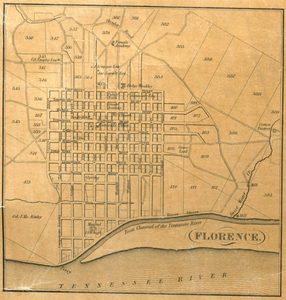
John LaTourrette, 1837; Historical Maps of Alabama.
Florence’s earliest commercial activity clustered near the river rather than around the later downtown business district. A historical marker describing the founding of Florence notes that the earliest business district was at the river’s edge, where warehouses and a hotel stood. Development then worked its way northward up Court Street.
One of the best descriptions comes from traveler Anne Royall, who visited the young town around 1820. Florence had existed only a few years, yet Royall estimated that it already contained about 100 houses and stores, a courthouse and several warehouses. Importantly, she added that the warehouses were “on the river.” She considered Florence particularly well situated for commerce because of its location at the head of steamboat navigation.
A later history described Florence as an important regional distribution point where merchandise arriving by river was stored before being carried inland to places such as Huntsville, Athens and Fayetteville, Tennessee. Agricultural products coming from the surrounding countryside moved through the same system in the opposite direction. By the 1820s, warehouses were being erected along the Florence riverbank specifically to handle this growing trade.
This riverside commercial area eventually became remembered as North Port. The name was primarily descriptive: it was the port or landing on the north bank opposite South Port. Later accounts specifically identify Florence’s early port as North Port.
South Port Becomes a Commercial Center of Its Own
Across the river, South Port was developing just as rapidly. Historian Nina Leftwich wrote in Two Hundred Years at Muscle Shoals that the old ferry crossing connected the two banks and that the landing opposite Florence continued to be known among older residents as South Port, even as South Florence became the more common name.
By the early 1820s, Leftwich recorded eight large wholesale houses at South Port.
Contemporary notices from the Tuscumbian in 1825 identified merchants and commission businesses operating there, including Robert Black; Hugh Findlay; Banks, Mason & Company; Thomas P. Adams and Edward Jones; and Simpson & Dickson. Findlay was specifically described as a storage and commission merchant—a business built around receiving, storing and arranging the shipment of goods.
South Port was therefore more than a ferry landing. It had become a small warehouse and mercantile community. Its importance was reflected in transportation routes as well. An early mail stage ran from Huntsville through Tuscumbia to South Port, specifically serving steamboat passengers traveling through South Port and Florence.
Cotton Fueled the Warehouse Trade
Behind much of this growth was cotton. By the 1830s, cotton dominated much of the agricultural economy surrounding Florence. Warehouses provided a place where bales could accumulate until river conditions and transportation allowed them to be shipped.
The same buildings also held merchandise coming back upriver—tools, manufactured goods, foodstuffs, household items and other commodities that were then distributed across North Alabama and southern Middle Tennessee.
It was a two-way trade. Cotton and other agricultural products went out. Manufactured goods came in. And because much of the antebellum cotton economy depended upon enslaved labor, the prosperity represented by these warehouses was inseparable from the system of slavery that produced much of the region’s cotton.
South Port Declines—and Then Returns
South Port’s fortunes were not always steady. The construction of the Tuscumbia-to-Decatur railroad in the 1830s temporarily pulled commercial activity away from the river settlement. Leftwich wrote that many residents and merchants moved toward Tuscumbia, believing the railroad would make that town the great commercial center of the region.
But South Port did not disappear. As the initial excitement surrounding Tuscumbia subsided, business returned to the river. In 1841, a merchant named Price arrived from Lawrence County and established the firm that became Price & Simpson. Together with the general store operated by Walker, these businesses became fixtures of South Port commerce.
Business eventually became substantial enough that large cotton sheds were erected from the bridge upstream along the river.
Florence merchants also maintained interests across the river. William B. Wood later recalled that brothers Thomas and James Kirkman, among Florence’s wealthiest early merchants, operated an extensive business in Florence and another store in South Florence.
The Florence Bridge Changes the Riverfront
For the first two decades of Florence’s existence, the ferry was the essential link between the two banks. Then came the bridge.
The Alabama Legislature authorized the Florence Bridge Company in 1832, and the first permanent toll bridge opened across the Tennessee River in 1840. That changed the relationship between North Port and South Port considerably.
What had been two river landings connected by ferry now became warehouse districts connected directly by road. Travelers, wagons, cotton and merchandise could move between Florence and the south bank without waiting for a ferry crossing.
South Port gradually became known as South Florence, apparently because it functioned increasingly as an extension of the larger town across the river. Local histories specifically note that Florence residents used the South Florence name because the Florence ferry (and later the bridge) connected directly to the settlement.
A Remarkable Description of South Florence in 1851
One of the most interesting firsthand descriptions of the community survives because of an entirely unrelated and much more dramatic story.
In 1851, abolitionist Seth Concklin secretly traveled into Alabama while attempting to help members of the Still family escape slavery. While in the Shoals, he spent time around South Florence and wrote letters describing what he saw. His description is short but invaluable.
South Florence, he wrote, contained about 20 white families, a post office and:
“three warehouses of considerable business.”
He also described Florence as the head of navigation for small steamboats. It paints a useful picture of South Florence in the early 1850s: not a large town, but a small settlement whose commercial importance was far greater than its population might suggest.
The post office was significant as well. Records indicate that a South Florence post office operated intermittently beginning in the 1820s and continued well into the late 19th century.
The Two Warehouse Districts in 1854
The 1854 Southern Business Directory provides another snapshot. Florence was listed separately in Lauderdale County with a long roster of merchants. Across the river in what was still Franklin County, the directory specifically listed:
SOUTH PORT P.O. — Price & Simpson; Walker, J. H.
The old South Port name clearly had not disappeared, even though contemporary letters were already using South Florence. That same year, disaster struck the riverfront.
On March 10, 1854, a tornado passed through the Florence landing, destroying warehouses and badly wrecking the Florence Bridge. A contemporary report said nearly every building at the landing had been destroyed. Among the businesses suffering damage were Kirkman & Rice, C. Gookin and Simpson, McAlister & Company.
Precisely which bank held every warehouse mentioned in the report is not clear enough to state with certainty. What is clear is that by this time the bridge, the two landings and the warehouse districts surrounding them functioned as a closely connected commercial system.
Then the Railroad Arrived
The next major transformation came only a few years later. The main line of the Memphis & Charleston Railroad passed through Tuscumbia on the south side of the Tennessee rather than through Florence. Florence businessmen wanted access to it. The result was a railroad branch from Tuscumbia through South Florence and across the river into Florence.
The old bridge was replaced with a remarkable double-deck structure. Trains used the upper level while wagons and other traffic crossed on the lower deck. The railroad connection was completed around 1858–1860.
The railroad bed that later became Ashe Boulevard ran through South Port toward the bridge. Historical accounts state that large warehouses lined both sides of the railroad bed to handle the area’s cotton trade.
In 1860, the railroad was reportedly using warehouses at South Florence and even repositioned them so they ran parallel with the tracks. That small detail says quite a bit about how commerce had changed. The warehouses had originally been oriented around the river. Now they were being oriented around the railroad.
South Florence had become an early transportation hub where river, road, bridge and railroad all came together.
The Civil War Nearly Erases South Port
The prosperity did not last. The Civil War devastated the transportation and industrial infrastructure of the Shoals. The railroad bridge across the Tennessee was burned in April 1862.
South Port’s warehouse and mercantile businesses were also destroyed during the war. Leftwich wrote that Price & Simpson and Walker’s business establishments operated until they were destroyed during the conflict, while later local histories say the war virtually destroyed South Port. The strategic importance of the old port did not disappear, however.
In 1864, Confederate Gen. John Bell Hood’s army used South Port as one of its Tennessee River crossing points during the campaign that preceded the Battle of Franklin. The surviving bridge piers were used to help anchor a pontoon crossing. The same geography that had attracted merchants now attracted armies.
South Florence After the War
South Florence survived, but its role changed. A new railroad depot measuring approximately 30 by 70 feet was erected at South Florence in 1867, and the railroad bridge was rebuilt by the end of the decade.
The 1870 federal census still used South Florence as a post-office designation for a substantial portion of the surrounding area. But the commercial landscape of the Shoals was changing rapidly.
Railroads were replacing the river as the dominant form of inland transportation. Tuscumbia remained an important railroad center, and beginning in the 1880s the development of Sheffield created an entirely new industrial city almost on top of the old South Florence transportation corridor.
The name South Florence remained in use for years, but the old warehouse-port community gradually disappeared into the expanding industrial landscape.
North Port Changes Too
Florence’s riverfront experienced a similar evolution. The earliest warehouses below Court Street had helped establish Florence as a regional trading center, but over time the commercial heart of the city migrated uphill.
Stores and businesses increasingly concentrated along Court and Tennessee streets while railroads and later industries changed the use of Florence’s riverfront. Cotton nevertheless remained important.
In 1887, Florence businessmen constructed a cotton compress with local capital. Contemporary accounts said about 10,000 bales of cotton were then being received annually and predicted that additional warehouses would increase Florence’s importance as a cotton market.
It was a newer version of the same business that had begun along the river more than sixty years earlier.