
By 1829, the Cherokee Nation in the Southeast was under enormous pressure. Georgia was pushing to extend its authority over Cherokee lands, white settlers were moving into disputed territory, and the federal government was moving steadily toward a policy of Indian removal.
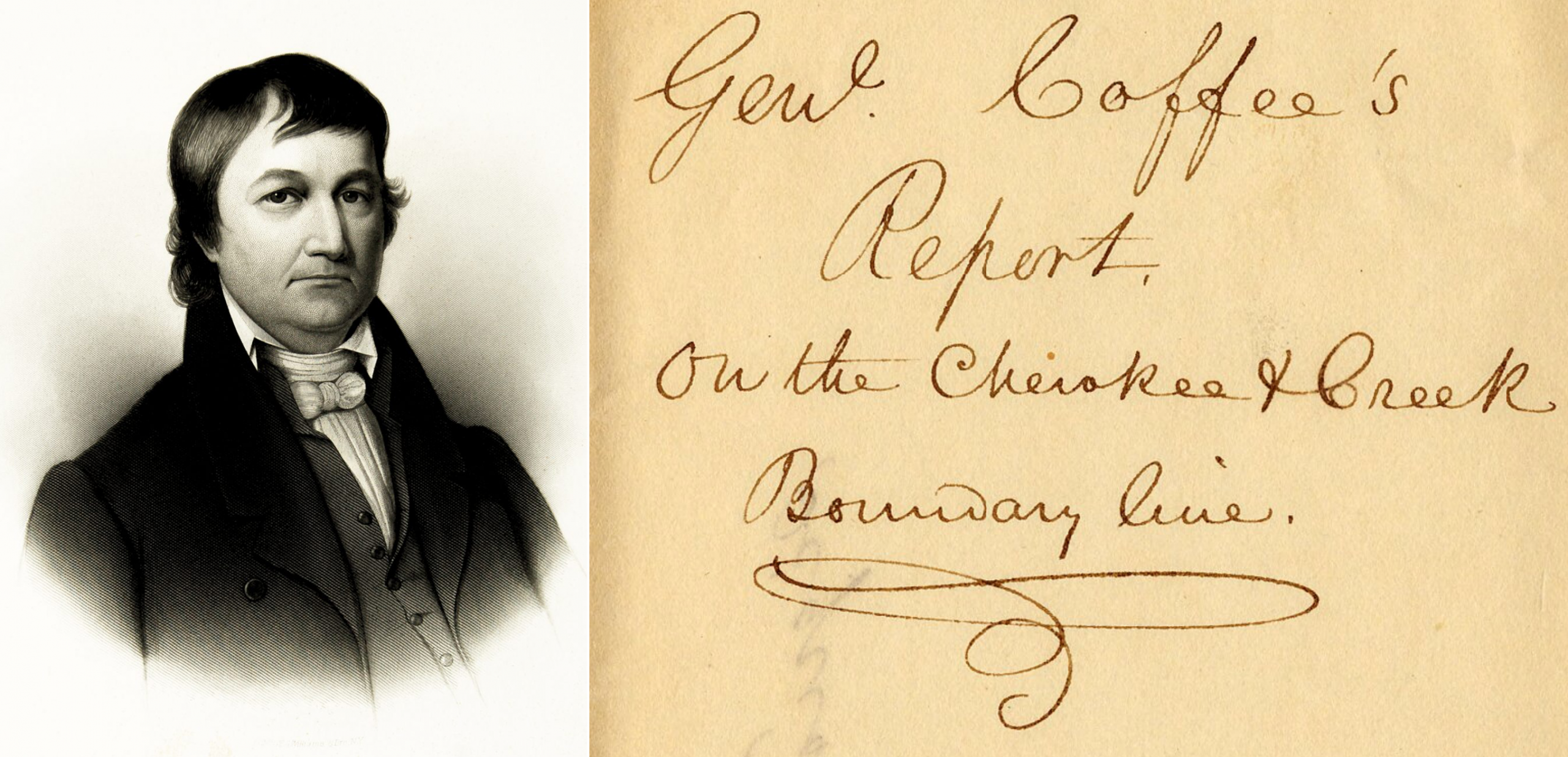
Caught in the middle of one dispute was General John Coffee, a man closely connected to the early history of North Alabama and Florence. What began as a disagreement over a boundary eventually led Coffee to conduct something surprisingly close to an oral history project; interviewing elderly Cherokee residents and longtime frontier settlers about a past that was already disappearing.
John Coffee and the Southern Frontier
Born in Virginia in 1772, Coffee moved to Tennessee in 1798 and became a close friend, business associate and military companion of Andrew Jackson. During the War of 1812, he served under Jackson in campaigns against the Creeks and later at the Battle of New Orleans.
After the war, Coffee became a surveyor and helped establish several important boundaries in what became Alabama. He also played a significant role in the early development of Huntsville and Florence, where he eventually made his home.
His surveying work brought him directly into disputes involving Cherokee, Creek, Chickasaw and Choctaw lands.
In 1816, Coffee was tasked with determining portions of the boundaries between these nations. One particularly important line ran from near present-day Gadsden, Alabama, eastward to the Chattahoochee River in Georgia. After considerable confusion and disagreement, the boundary Coffee helped establish was approved in 1817. For more than a decade, the matter appeared settled. It wasn’t.
Georgia Challenges Coffee’s Boundary
In 1828, Georgia Governor John Forsyth argued that the Cherokees were occupying land that historically belonged to the Creeks, and that the land should therefore belong to Georgia.
Georgia’s proposed boundary would have shifted the line roughly fifty miles north in places and potentially added more than one million acres to the state’s territory. Just as importantly, shrinking Cherokee territory could increase pressure on Cherokee families to move west.
Georgia commissioner Samuel A. Wales collected testimony supporting the state’s claim. But there was a problem: much of it came from people who had arrived in the area relatively recently and were repeating what they had heard from others.
President Andrew Jackson turned to someone who already knew the disputed boundary well. John Coffee.
Coffee Goes Looking for the Truth
In November 1829, Coffee traveled into the Cherokee Nation to investigate.
Almost immediately, he became suspicious of the evidence being presented to him. He discovered that Wales’ report included testimony favorable to Georgia while leaving out witnesses who did not support the state’s position. Coffee also found large portions of the supposed historic boundary poorly documented.
Rather than relying primarily on younger settlers or secondhand stories, Coffee sought people old enough to actually remember the region before 1800.
He eventually interviewed more than thirty Cherokee and white witnesses, recording not only what they said but also their ages, backgrounds and whether he considered their testimony credible.
In doing so, Coffee accidentally preserved a remarkable collection of memories about Cherokee life in Georgia and Alabama during the late 1700s.
Memories of a Disappearing Cherokee World
A Cherokee man named Rising Fawn, who was believed to be nearly 100, remembered communities such as Standing Peachtree and Shallowford as Cherokee settlements. He regularly hunted around Sweetwater near the Chattahoochee River and never considered himself to be in Creek territory.
Another Cherokee known as Flute, or Old Turkey, remembered helping Creek representatives establish a boundary during negotiations in 1802.
Others recalled villages, hunting grounds, trails, stores, farms and military campaigns stretching back to the American Revolution.
Coffee’s interviews mentioned Cherokee communities including Turkey Town, Pine Log, Hickory Log, Sixes, Sand Town, Cedar Town, Red Bank and Silacoa.
Rising Fawn claimed that the Cherokee community of Sweetwater was named for a Cherokee man who lived there and not for a spring. The testimony also referred repeatedly to Standing Peachtree, helping challenge later stories that Atlanta’s famous “Peachtree” name originated from a “pitch tree.”
What Coffee Concluded
After weighing the testimony, Coffee rejected Georgia’s claim and concluded that the Cherokees and Creeks had once shared a large area as a common hunting ground and that the boundary he surveyed in 1817 represented a compromise between competing claims.
Coffee ultimately recommended another compromise line running roughly along the watershed dividing the Etowah River system from the Chattahoochee. President Andrew Jackson accepted his recommendation, and the Cherokees agreed to withdraw their remaining settlements south of the new line.
But by then, the larger question of Cherokee land ownership was moving toward a much darker conclusion.
A History Preserved Before Removal
The boundary dispute soon became almost irrelevant as Georgia expected the federal government to remove the Cherokees entirely, and within a decade that expectation became reality. The forced Cherokee removal remembered as the Trail of Tears began only a few years after Coffee’s investigation.
Coffee never lived to see it. He died at his home in Florence, Alabama, on July 7, 1833, five years before the Cherokee removal. His investigation left behind something more valuable than the boundary he was sent to determine.
By questioning elderly Cherokee residents and frontier settlers about where they had lived, hunted and traveled decades earlier, Coffee preserved firsthand memories of Cherokee communities stretching across northern Georgia and into Alabama during the late eighteenth century.
Source: Davis, Robert. “JOHN COFFEE’S SEARCH FOR THE LOST HISTORY OF THE CHEROKEES i.” Chattanooga Regional Historical Journal, 2005.
Source: Coffee, John, 1772-1833. “Report of General John Coffee on the boundary line between the Creeks and Cherokees, 1829, Dec. 30, Florence, Alabama [to] John H. Eaton / Jo[h]n Coffee.” Hargrett Library. 1829-12-30, https://dlg.usg.edu/record/dlg_zlna_tcc697#item.