
Barton Agricultural Works traced its beginning to 1881. By the early twentieth century, its stationery proudly advertised the company as the manufacturer of “The Celebrated Barton Cultivators.” But the story may actually begin a few years earlier.
On September 24, 1878, the United States Patent Office granted Patent No. 208,284 to Clark Talbot Barton of Tuscumbia, Alabama, for an improvement in cultivators. The patent specifically identifies Barton as a resident of Tuscumbia in Colbert County. Just three years later, Barton Agricultural Works was established.
Whether the company was created to manufacture Clark Barton’s patented cultivator has not yet been proven. But the timing, location, name and product are strikingly similar. Together they offer a peek into a nearly forgotten piece of the Shoals’ industrial history.
Clark Talbot Barton’s 1878 Cultivator
Clark Talbot Barton was trying to solve a practical problem faced by farmers throughout the South. Cultivating corn, cotton and other row crops required different tools at different stages of the growing season. Farmers might need to loosen soil, remove weeds, throw dirt toward plants, scrape the ground or prepare planting beds.
Buying a separate implement for every task could be expensive. Barton designed one machine that could perform several of them. In his patent, Barton explained that his goal was to create a cultivator that would be simple in construction, light and strong, while also being easily adjustable.
The machine could function as either a two-plow or three-plow cultivator and could also be arranged for use as a two-horse cultivator. Its most interesting feature was the design of its plow plates. By repositioning them, the farmer could turn the same pieces into a:
- shovel
- half-shovel
- scraper
- sweep
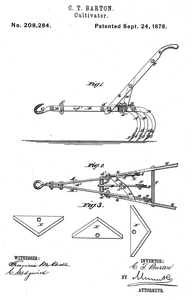
Barton’s patent drawing shows the cultivator from both the side and above, along with the different positions of the interchangeable plow plates.
The patent specification explains that when the triangular plates were positioned one way, they worked as half-shovel plows. They could even be reversed as they wore down, extending their useful life.
Changing their orientation converted them into full shovel plows, scrapers or sweeps. The operator could also arrange them to throw dirt either toward or away from the crop. For a farmer working behind a mule or horse, that versatility would have been valuable.
One Machine, Several Jobs
Barton’s machine could do more than cultivate between established rows. The patent describes another configuration specifically for forming a planting bed. By moving the center beam and repositioning the plow plates, the forward plow opened a furrow while the two rear plows threw soil onto it, creating the raised bed.
With another adjustment, Barton wrote that the machine became “an excellent seed-coverer.” In other words, Barton was not simply patenting a plow. He was attempting to create a multipurpose farm implement that could perform several jobs while minimizing the number of separate tools a farmer needed.
His final patent claim protected the particular arrangement of the center beam, side beams, cross-bar and related hardware that made the adjustable design possible.
Barton Agricultural Works Is Established
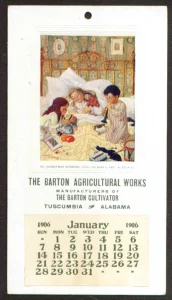
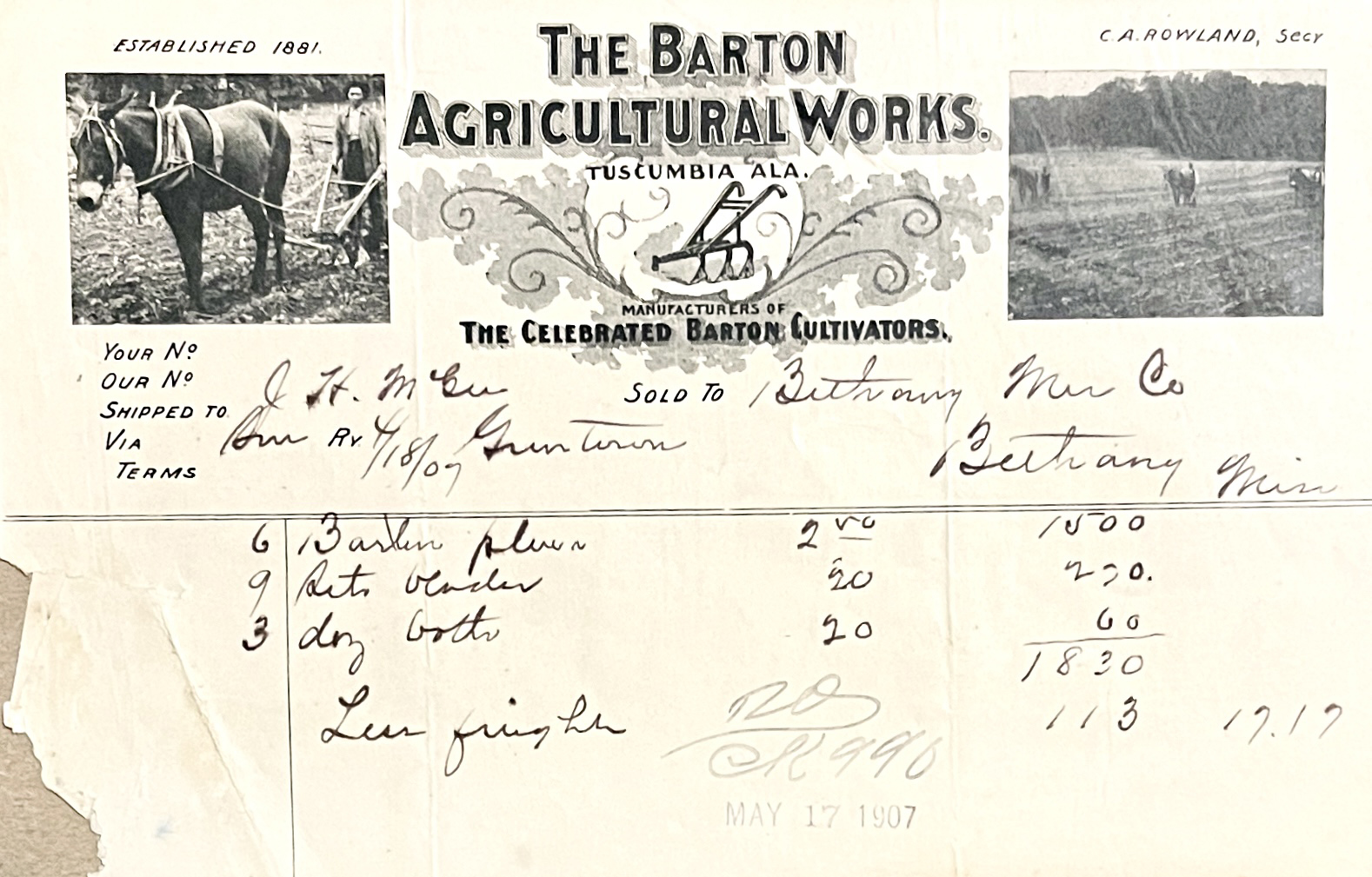
Only three years after Barton received his patent, Barton Agricultural Works began operation in Tuscumbia. We know this from an unusually valuable surviving piece of company stationery. A Barton Agricultural Works invoice dated 1907 carries an elaborate printed letterhead. Across the upper-left corner are the words: ESTABLISHED 1881. Centered across the top is: THE BARTON AGRICULTURAL WORKS, TUSCUMBIA ALA.
Beneath that appears an illustration of a cultivator and the proud claim: “Manufacturers of The Celebrated Barton Cultivators.” The document therefore provides the company’s own stated founding date.
Barton Agricultural Works was not founded in 1884, as its later incorporation record might initially suggest. It had apparently already been operating for approximately three years.
Incorporated in 1884
On December 9, 1884, Barton Agricultural Works was formally incorporated. Its authorized capital was $4,000.
The incorporators were:
- T. T. Rowland
- John R. Price
- Charles A. Rowland
This may indicate that an existing enterprise established in 1881 was reorganized under a formal corporation three years later. Exactly who established the original business in 1881 remains uncertain. Nor has a document yet surfaced explaining Clark Talbot Barton’s relationship to the later company.
But the chronology deserves attention:
1878 — Clark Talbot Barton of Tuscumbia patents an improved cultivator.
1881 — Barton Agricultural Works says it was established.
1884 — Rowland, Price and Rowland formally incorporate Barton Agricultural Works.
1907 — The company advertises itself as the manufacturer of “The Celebrated Barton Cultivators.”
That sequence makes a connection between Clark Barton’s invention and the later company entirely plausible. What we still lack is the document that proves it.
Was the Company Named for Clark Barton?
The discovery of Clark Talbot Barton also complicates another question: where did the name Barton Agricultural Works come from?
There was already a community known as Barton Station west of Tuscumbia during the nineteenth century. It would therefore be easy to assume that Barton Agricultural Works was named for the community or perhaps operated there. But the surviving company material consistently identifies the business as being in Tuscumbia.
And now we know that a man named Clark Talbot Barton, living in Tuscumbia, patented precisely the kind of agricultural implement that the company later became known for manufacturing. That raises another possibility.
The company may have taken its name from the Barton cultivator, and the implement itself may have carried the name of its inventor. At present, that remains a hypothesis. No evidence yet found explicitly states that Barton Agricultural Works owned Patent No. 208,284, acquired it from Clark Barton or manufactured his exact patented design.
“The Celebrated Barton Cultivators”
Whatever its origin, by the early twentieth century the Barton name had clearly become part of the company’s branding. The 1907 letterhead does not merely advertise cultivators. It advertises: “The Celebrated Barton Cultivators.”
That is the language of a company selling a named product with an established reputation. The stationery itself is surprisingly elaborate. On either side of the company name are actual photographic scenes showing animal-powered farming.
The photograph on the left shows a horse or mule pulling a cultivator through a field with the operator walking behind. The photograph on the right shows another field scene with an animal-drawn implement in use. Between the two photographs is an illustration of a Barton cultivator.
For a relatively small Tuscumbia manufacturer, this was sophisticated advertising. The company had a recognizable product name, printed sales material and imagery showing customers how its equipment was intended to be used.
Tuscumbia’s Plow Factories
Barton Agricultural Works emerged during a period when the Shoals was becoming increasingly industrialized. Agriculture still dominated much of the surrounding economy, but Tuscumbia, Sheffield and nearby communities were attracting factories and workshops during the late nineteenth century.
An 1888 history of northern Alabama specifically included “plow factories” among the industries operating in Tuscumbia and Sheffield. Barton Agricultural Works had been established seven years earlier and incorporated four years earlier. Although that account does not identify the individual plow factories, Barton Agricultural Works is an obvious possibility.
Thousands of farms throughout north Alabama, Mississippi and Tennessee depended upon horses and mules. Those farms required plows, cultivators, sweeps, shovels, bolts and replacement parts. Barton Agricultural Works was manufacturing the machinery used in the region’s most important industry.
Charles A. Rowland
The 1907 invoice provides another valuable clue about the company. Printed in the upper-right corner is: C. A. ROWLAND, Sec’y. This was apparently Charles A. Rowland, one of the three men who had incorporated Barton Agricultural Works in 1884. More than two decades later, Rowland was still serving as company secretary. That suggests considerable continuity in the management of the business.
Rowland was apparently not simply an original investor who soon moved on. He remained closely associated with Barton Agricultural Works for much of its known existence. The roles of fellow incorporators T. T. Rowland and John R. Price remain less clear.
Selling Barton Plows Beyond Alabama
The 1907 invoice also provides important evidence about the company’s market. The handwritten document appears to record a sale to a mercantile company at Bethany, Mississippi. Among the items listed are what appear to be several Barton plows, along with smaller parts or hardware.
A postal or payment stamp on the invoice is dated May 17, 1907. Even if every piece of the handwritten order cannot yet be deciphered with certainty, the destination is significant. Barton Agricultural Works was doing business outside Alabama.
Its products were being supplied through merchants in neighboring states. That pushes the company beyond the image of a small local blacksmith operation serving only farmers around Tuscumbia. It had at least a regional commercial reach.
Still Active in 1910
Evidence from South Carolina shows that the company was still promoting its equipment several years later. In October 1910, a South Carolina newspaper published the premium list for an agricultural corn exhibition. Businesses and manufacturers provided prizes for winning farmers.
Among the prizes was a cultivator furnished by: Barton Agricultural Works, Tuscumbia, Alabama. The same broader prize list included equipment from nationally known manufacturers such as the John Deere Plow Company. That small reference is important.
It establishes that Barton Agricultural Works remained active (or was at least still actively marketing its cultivators) in 1910.
From its stated establishment in 1881, the company had existed for at least 29 years.
It shows just how far the Barton name had traveled. A cultivator manufactured or marketed by a Tuscumbia company was being promoted to farmers hundreds of miles away in South Carolina.
Competing With the Big Manufacturers
By 1910, Barton Agricultural Works was operating in a rapidly changing industry. During much of the nineteenth century, agricultural equipment was frequently manufactured by local and regional companies.
Farmers purchased equipment made relatively close to home, and regional manufacturers could adapt their products to local crops and farming practices. Railroads gradually changed that market. Large manufacturers could ship mass-produced machinery almost anywhere.
Companies such as John Deere and International Harvester developed extensive dealer networks, large factories and national advertising campaigns.Smaller regional companies increasingly had to compete with industrial giants.
The South Carolina exhibition captures that change particularly well.
A Barton cultivator from Tuscumbia appeared in the same promotional environment as machinery produced by John Deere. One would become an international corporation. The other has nearly disappeared from memory.
What Did a Barton Cultivator Look Like?
The 1878 patent provides the best detailed view currently available of an early Barton cultivator design. The drawing shows a remarkably simple-looking machine.
A draft hook at the front attached the implement to the animal. Long beams extended backward toward three working plow plates. Handles allowed the farmer to guide the cultivator while walking behind it. The genius of Barton’s design was not elaborate machinery. It was adaptability.
The farmer could change the arrangement of the beams and blades depending upon the job being performed. The machine could cultivate. It could scrape. It could sweep. It could form beds. It could cover seed. And parts of it could be reversed as they wore down. That was exactly the sort of practical engineering that mattered on a nineteenth-century farm.
Where Was Barton Agricultural Works?
The precise location of the works itself remains uncertain. The surviving company stationery clearly states: Tuscumbia, Ala. The 1910 South Carolina reference likewise identifies the company with Tuscumbia.
No confirmed factory photograph, deed or detailed directory entry has yet been located identifying the plant’s exact site. The existence of Barton Station west of Tuscumbia has led to the possibility that the factory may have been located there, but at present there is no evidence proving that.
The newly documented role of Clark Talbot Barton provides an equally plausible explanation for the company name. Until stronger evidence appears, the most accurate description remains simply: Barton Agricultural Works of Tuscumbia, Alabama.
When Did the Company Close?
Exactly when Barton Agricultural Works disappeared is another unanswered question. The evidence currently provides this timeline:
September 24, 1878
Clark Talbot Barton of Tuscumbia receives U.S. Patent No. 208,284 for an improvement in cultivators. US208284
1881
Barton Agricultural Works later identifies this as the year the company was established.
December 9, 1884
The business is formally incorporated by T. T. Rowland, John R. Price and Charles A. Rowland with $4,000 in authorized capital.
1888
A published description of area industry mentions plow factories operating around Tuscumbia and Sheffield.
1907
Company stationery advertises “The Celebrated Barton Cultivators,” identifies C. A. Rowland as secretary and records an apparent sale to a merchant in Mississippi.
1910
Barton Agricultural Works supplies a cultivator as a prize for an agricultural exhibition in South Carolina.
For now, 1910 is the latest definite evidence of the company’s activity.
Whether Barton Agricultural Works disappeared soon afterward or continued into the following decade remains unknown.
Could a Barton Cultivator Still Survive?
There is a good chance that physical evidence of the company still exists. Farm implements were built to survive hard use. When tractors replaced horses and mules, old cultivators and plows were often pushed into barns, sheds and fence rows rather than thrown away.
Cast or stamped components frequently carried the manufacturer’s name. Somewhere in Alabama, Mississippi or Tennessee, an old plow or cultivator may still carry the words: BARTON AGRICULTURAL WORKS or simply: BARTON
A surviving machine could potentially answer several questions. Its construction could be compared with Clark Talbot Barton’s 1878 patent. Casting marks could identify where components were manufactured. A model name or patent number could establish the long-suspected connection between Barton’s invention and Barton Agricultural Works.
More than a century later, the missing evidence may not be in an archive at all. It may be sitting in somebody’s barn.