
On an early March morning in 1854, a violent tornado struck the Tennessee River at Florence, tearing apart one of the city’s most important pieces of infrastructure and devastating the warehouses clustered around the river landing.
The 1854 Florence, Alabama tornado apparently followed a remarkably narrow path. Florence itself escaped the worst of it. The riverfront did not.
Within days, newspapers elsewhere in the South were reporting the disaster. The Daily Morning News of Savannah, quoting the Chattanooga Gazette, reported that a “fearful and destructive Tornado” had swept past Florence and continued in the direction of Decatur. It specifically mentioned damage to the Florence Bridge and several brick warehouses near the river.
A much more detailed account appeared in the Florence Gazette and was later reprinted by the New York Times on March 28, 1854.
Florence’s Commercial Front Door
To understand the significance of the 1854 Florence, Alabama tornado disaster, it helps to picture Florence in 1854.This was long before highways, trucks or even a railroad connection into the city. The Tennessee River was one of Florence’s principal transportation routes, and the river landing functioned almost like the loading docks of a modern distribution center.
An 1854 business directory described Florence as a town of about 1,200 people, situated at the foot of the Muscle Shoals and at the head of steamboat navigation. The directory listed numerous merchants operating in the town, including several of the businesses that would appear in reports of the tornado: Kirkman & Rice, C. Gookin, and Simpson & McAlister.
Warehouses had been part of Florence’s riverfront from the town’s earliest years. A later history recalled that large warehouses lined the river to receive merchandise intended not only for Florence, but also for Huntsville, Athens, Fayetteville and other inland communities. Florence served as an important distributing point for goods moving into and out of North Alabama and southern Middle Tennessee.
The Florence Bridge
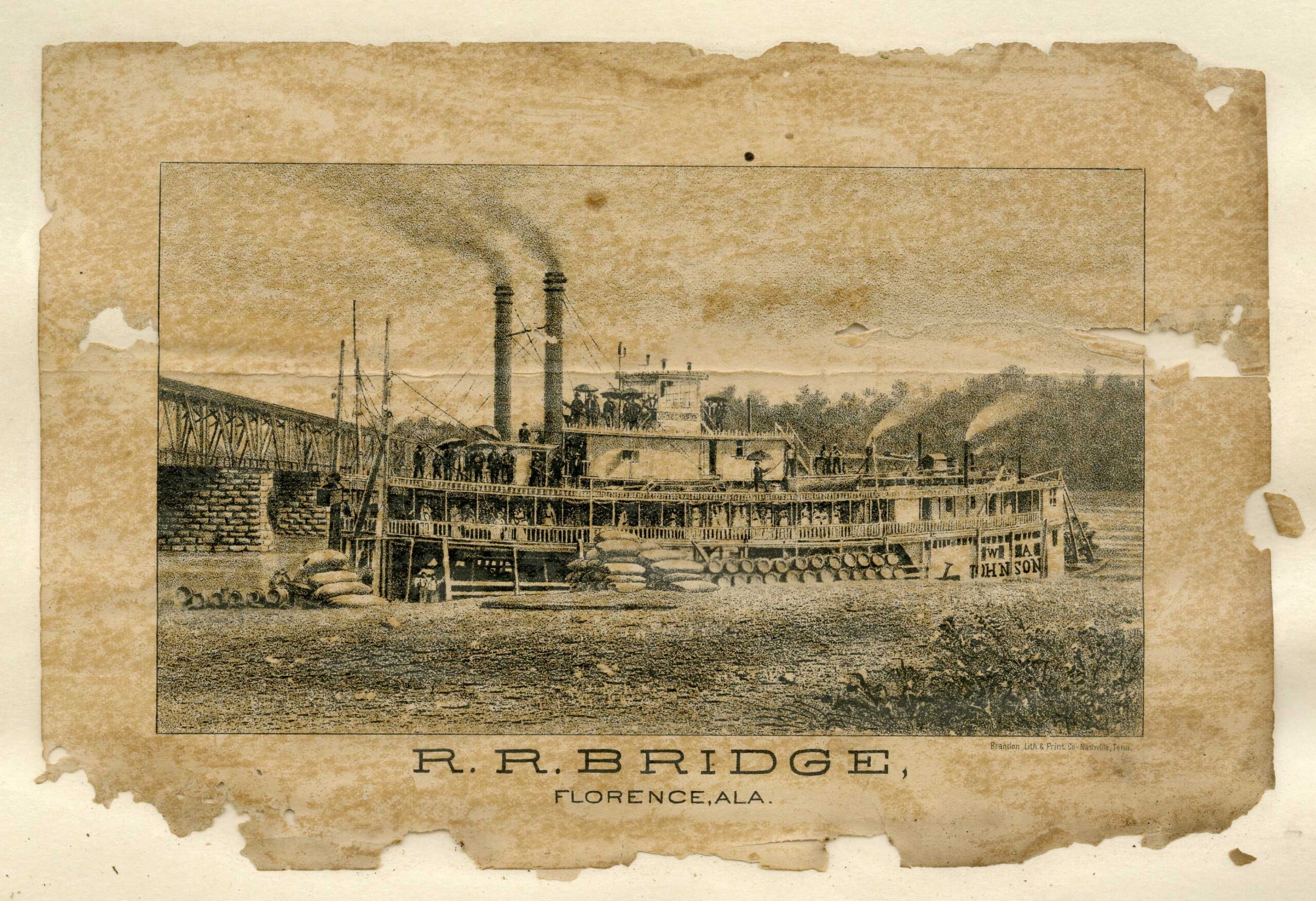
The greatest single loss of the 1854 Florence, Alabama tornado was the Florence Bridge across the Tennessee River.
The Alabama Legislature had incorporated the Florence Bridge Company in January 1832. Its charter authorized subscriptions of $60,000 in company stock, while the existing ferry and its landings were valued at another $35,000. The company was allowed to charge tolls, although those tolls could not exceed what travelers had previously paid to cross by ferry.
The bridge was finally completed in 1840. Historical engineering records describe it as a timber structure of roughly eight spans. It was a tremendous investment for a town the size of Florence. The 1854 newspaper account placed its cost at $165,000 – roughly $6 million in today’s purchasing power, although its relative economic significance as a major infrastructure project would be closer to $110 million or more today.
Then came March 10. According to the account reprinted by the New York Times, the bridge was blown down except for two spans, with parts of the structure carried away by the river. Making the financial blow even worse, the bridge was reportedly insured against fire but not against wind.
The newspaper identified five men who bore much of the loss: James Irvine, James H. Weakley, John Simpson, Robert M. Patton and Martin Harkins. These were hardly obscure names in early Florence.
James H. Weakley had been appointed Florence’s first postmaster in 1821 and later succeeded John Coffee as Surveyor General of the Public Lands in Alabama. John Simpson was one of Florence’s leading merchants and served as mayor from 1839 until 1852. James Irvine had also served as mayor.
Robert M. Patton was a Florence merchant and plantation owner who would later become governor of Alabama following the Civil War. Patton also owned what became known as Patton Island, directly opposite the bridge.
Martin Harkins was another Florence merchant. Newspaper advertisements from the 1840s show Harkins operating a mercantile business on Court Street with his brother John.
In other words, the tornado struck an enterprise backed by some of the most prominent businessmen and civic leaders in early Florence.
Warehouses Flattened at the Landing
The bridge was only part of the destruction. The Florence Gazette reported that nearly every building at the landing was destroyed. One of the hardest-hit businesses was Kirkman & Rice.
Their newly constructed brick warehouse was reportedly leveled to the ground, leaving what the newspaper described as a mass of ruins. A second, large frame warehouse used for storing cotton was also completely destroyed. Pieces of lumber were said to have been blown half a mile. The firm’s loss was estimated at approximately $2,000.
Kirkman & Rice was a significant Florence mercantile operation. Thomas Kirkman had moved to Florence in 1821 and became one of the town’s wealthiest merchants.
The “Rice” was future Florence Mayor, Neander H. Rice. Lauderdale County probate records show that Kirkman and Rice had earlier been partners with Robert Andrews in the firm Kirkman, Andrews & Co., organized in 1845. After Andrews’ death, Kirkman and Rice continued the business, which appears in the 1854 directory simply as Kirkman & Rice.
Despite the destruction of the 1854 Florence, Alabama tornado, the firm survived. Lauderdale County court records still show Kirkman & Rice conducting business in 1857.
C. Gookin’s Warehouse
Another warehouse belonged to C. Gookin, identified through other Florence records as merchant Charles Gookin. His warehouse was also left in ruins. Worse, it was reportedly nearly full of merchandise when the storm struck, leaving much of its contents damaged. His loss was estimated at another $2,000.
Gookin had been part of Florence’s mercantile community for years. Court records identify Charles Gookin as a Florence merchant as early as 1849, and newspaper records show that he had previously been in business with James Irvine and Francis W. Boggs before that partnership dissolved in 1842. The 1854 business directory still listed C. Gookin among Florence’s general merchants.
Simpson, McAlister & Co.
The brick warehouse occupied by Simpson, McAlister & Co. was more fortunate. It suffered damage, but the newspaper described it as not serious. The firm also appears in the 1854 directory among Florence’s general merchants.
It continued operating well beyond the tornado. A later federal court case describes McAlister, Simpson & Co. as “merchants and factors” in Florence during the early 1860s, handling money and arranging commercial transactions as far away as New Orleans.
That helps explain why these river warehouses mattered so much. They were not simply storage sheds. They were part of a commercial network connecting Florence with regional and national markets.
Trees Uprooted and a Carriage Lost
The storm’s path could be followed through the landscape. Trees around the bridge and warehouses were blown down, some pulled from the ground by their roots. Timber was also heavily damaged across Patton Island, directly opposite the Florence landing.
The storm apparently remained confined to what the newspaper called a “very narrow compass.” That narrow path may have saved Florence from a far greater disaster.
The wind was reportedly severe in town, but the center of the storm did not travel through the more heavily populated portion of Florence. The Gazette reflected that had the same winds that struck the landing passed through town, the loss of both life and property might have been extreme.
There was, however, one particularly mysterious detail. A carriage was on the bridge when the storm struck. Afterward, it was gone.
The newspaper said authorities had been unable to determine whose carriage it was or even whether anyone had been inside. They knew only that the carriage had disappeared with the bridge. No confirmed fate of its occupants (if there were any) was given.
The Bridge Never Fully Recovered
Later accounts differ somewhat on exactly how much of the bridge survived the 1854 tornado.
The immediate newspaper report makes the destruction sound nearly complete, saying only two spans remained. Later Florence histories described the bridge as being partially destroyed in 1854, with what remained being lost during another major storm the following year. William B. Wood wrote in 1876 that the remainder was carried away by another wind in 1855, while a Historic American Engineering Record attributes the final destruction to the 1855 flood.
Whatever the precise sequence, the old Florence Bridge was effectively finished.
The Memphis and Charleston Railroad eventually acquired the Florence Bridge Company’s property and franchise, including its piers, and constructed a new combination railroad and wagon bridge. The Florence Gazette reported the new bridge open to wagons in October 1859, with regular railroad service beginning that December.
That crossing would itself have a long and complicated history involving war, fire, rebuilding and eventually the railroad bridge whose remains are still familiar in the Shoals today.
A Disaster at the Center of Florence’s Economy
The tornado of March 10, 1854, is easy to reduce to a sentence in local histories: The Florence Bridge was destroyed by a tornado. But the contemporary account reveals something much larger. For a few violent minutes, a tornado passed directly through the commercial gateway of Florence.
It destroyed warehouses filled with merchandise and cotton. It uprooted trees and scattered lumber across the riverfront. It damaged Patton Island. It carried away a carriage whose fate apparently remained unknown.
It wrecked a bridge that had taken years to organize, finance and build. One that represented an investment of roughly $150,000 to $165,000 in an era when Florence had only about 1,200 residents. The town itself had narrowly escaped.
Standing at the wharf afterward, the Florence Gazette described what remained as a “truly melancholy scene.” For Florence in 1854, it must have looked like an entire portion of the town’s economy had simply been blown away.