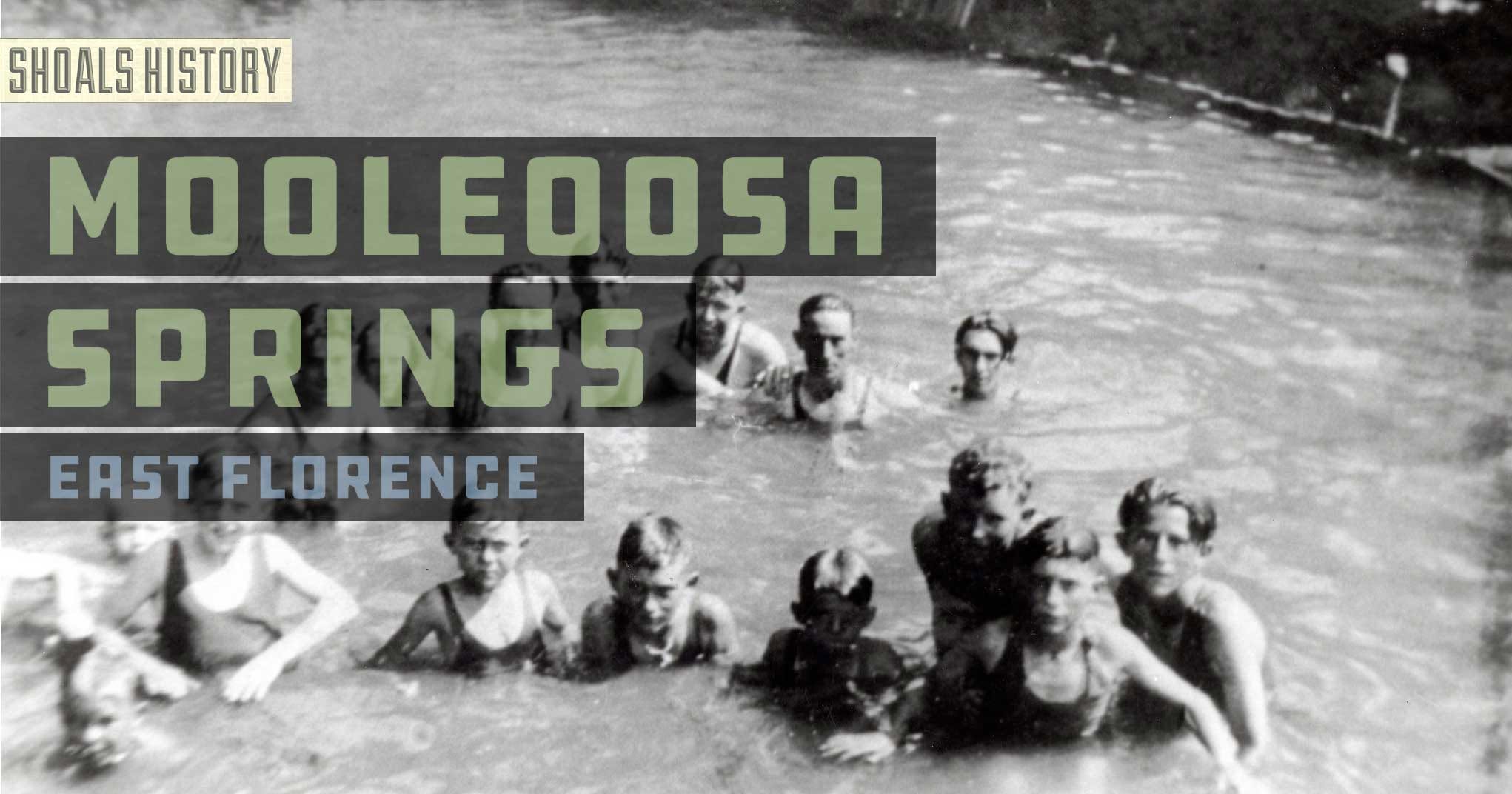

On April 23, 1890, the Florence Herald announced what it portrayed as one of Florence’s newest discoveries: a group of mineral springs in East Florence known as Mooleoosa Springs.
The springs were located about a mile and a half east of the Lauderdale County Courthouse, in an area of Florence that was then experiencing rapid development. The water had recently been analyzed, residents were already claiming medicinal benefits from drinking it, and investors were preparing to organize a company to develop the property into a sanitarium and resort.
Exactly one month later, on May 23, 1890, the Mooleoosa Springs Company was formally incorporated.
For a brief time, there were grand plans for Mooleoosa. Promoters imagined a wooded mineral-spring retreat connected to Florence by rail, supported by a large nearby hotel, and capable of attracting both the sick and pleasure seekers from outside the area.
But the story of Mooleoosa Springs is also part of the much older story of Sweetwater.
A Spring Already Known to the Neighborhood
Before anyone attempted to turn Mooleoosa into a commercial enterprise, the water served a much more practical purpose.
As East Florence developed, not every resident had a cistern or convenient access to the city water system. According to the Florence Herald, people living near the springs had been using the water simply for drinking. Then residents began claiming something more.
People suffering from various ailments reportedly believed that drinking the water improved their health. Physicians in that part of Florence also began taking an interest in the springs and observing the effects of the water.
The newspaper said the springs had been attracting attention around town for several weeks, but no public announcement was made until the water could be tested.
A qualitative analysis was eventually performed by Wilson and Sam Cowardin, the latter of whom was associated with engineering and surveying work in Florence.
The sample was described as clear, tasteless, possessing an “indigo tint,” and almost entirely free of organic matter. The analysis reported silicic acid, silicates, sulphates, phosphates, nitrates, iron compounds, lime, magnesia, sodium, potassium and other substances. Particular attention was given to the amount of phosphates.
From this analysis, the Herald declared Mooleoosa a “RARE and VALUABLE mineral and medicinal water.” The newspaper even published a lengthy list of residents and physicians who had either used the water or were said to testify to its medicinal value.
Those claims should be understood in the context of the time. During the 19th century, mineral springs were commonly promoted as treatments for a wide range of illnesses. Health resorts developed around supposedly therapeutic waters throughout the country. Surely you’ve heard of Florence’s Bailey Springs?
Whether Mooleoosa spring water actually possessed the medical benefits attributed to it is another matter. But in 1890, medicinal water meant opportunity and the location seemed ideal for development.
Florence’s Next Great Resort
Only about four blocks away stood the nearly completed Lauderdale Hotel. Land covered with native forest trees overlooked the springs, forming what the Florence Herald described as a natural park.
The Florence Dummy Railway passed only about two blocks south of the springs. In the eyes of Florence promoters, the pieces of a resort were already falling into place. Visitors could arrive in Florence, travel east by rail, stay at a substantial new hotel, and spend their time among wooded grounds and mineral springs.
The owners intended to form a stock company, purchase additional property, and fully develop the site. Their ultimate goal was, in the words of the Herald, to build:
“a grand sanitarium, as well as a summer and winter resort for pleasure seekers.”
Among the men at the head of the enterprise were Maj. J.H. Field and Dr. C.M. Watson. Field was already heavily involved in the development of East Florence through the McAlester Manufacturing Company and the nearby Lauderdale Hotel. Watson was one of the men promoting the supposed medicinal value of the spring water and was reportedly pushing the development forward with considerable energy.
The Mooleoosa Springs Company also considered leasing or purchasing the Lauderdale Hotel for use in connection with the proposed sanitarium. For a short time, the springs represented another part of the grand vision being promoted for Florence during the boom years of the late 1880s and early 1890s.
Where Did the Name “Mooleoosa” Come From?
The origin of the name is one of the more interesting parts of the story. In its April 23, 1890 article, the Florence Herald stated:
“These springs are called Mooleoosa, from an Indian word meaning Sweet Water.”
So far, that April 23 article is the earliest documented appearance of the name Mooleoosa that has been located.
The article appeared exactly one month before the Mooleoosa Springs Company was incorporated. At the time of publication, the newspaper reported that the owners were only then “forming a stock company” to develop the property. The water had recently been analyzed and the entire enterprise was still taking shape.
This suggests that Mooleoosa was closely associated with the creation and promotion of the new spring development, rather than being the long-established name of this part of Florence. In fact, Sweetwater was already being used as a local place-name before Mooleoosa appeared.
In June 1889, nearly a year before the springs company was organized, the Florence Herald advertised the office of Dr. John B. Morgan was located on “Royal Avenue, Sweetwater.” The following month, the newspaper reported the construction of a residence near the old schoolhouse on “Sweetwater street.”
So Sweetwater was already an established name in East Florence. That reverses what might otherwise seem like the obvious explanation.
Sweetwater did not develop from the name Mooleoosa. Instead, Mooleoosa appears to have been a name applied to a mineral-spring development within an area already known as Sweetwater.
The newspaper’s claim that Mooleoosa was an Native word meaning “Sweet Water” has also proven difficult to verify independently. No convincing connection has yet been found between the word and documented Chickasaw, Cherokee, Choctaw or Muscogee vocabulary. It is therefore safest to treat the translation as a claim made in 1890 rather than as established linguistic fact.
An Older Sweetwater Tradition
There may be an even older layer to the name. Local accounts concerning the nearby Brahan and Patton properties trace the Sweetwater name back decades before the industrial development of East Florence.
Gen. John Brahan acquired property in the area during the early 1830s, including a spring that later became associated with the home known as Sweetwater Plantation.
A later historical account claimed that the spring had originally been known by the Native name “Succatania,” supposedly meaning Sweetwater. Another version, attributed to Patton family descendant Mittie Owen McDavid, gave the name as “Succotania” and identified it as a Cherokee name for the stream.
Like Mooleoosa, however, the exact linguistic origin and translation of Succatania or Succotania remain uncertain. The tradition is still important because it demonstrates just how old the association between this part of Florence and the name Sweetwater had become.
It should also not automatically be assumed that the Brahan-Patton spring and the springs promoted as Mooleoosa in 1890 were the exact same water source without additional evidence. What can be said with confidence is that Sweetwater existed as a local place-name before Mooleoosa appeared.
The Resort That Never Came
The grand Mooleoosa sanitarium never materialized. Florence’s extraordinary growth during the late 1880s and early 1890s produced no shortage of ambitious plans, and not all of them survived beyond the promotional stage. Mooleoosa Springs appears to have been one of them.
The development of East Florence continued, but its future would be tied much more closely to industry than to mineral-water tourism. Within only a few years, large manufacturing concerns were operating throughout the Sweetwater area. The Cherry Cotton Mill, established in the early 1890s, became one of the major industrial operations in this part of Florence.
The mineral-spring resort envisioned in 1890 faded away. So did the name Mooleoosa.
Sweetwater Remains
For a brief moment, Florence promoters looked at a group of springs in East Florence and saw the beginnings of a fashionable health resort. The water was analyzed. Testimonials were gathered. A corporation was formed. Plans were made for a sanitarium, hotel accommodations, landscaped grounds and rail access.
And then the project largely disappeared from history. Mooleoosa was forgotten. But the older name survived.
Sweetwater was there before Mooleoosa, and Sweetwater remains long after Mooleoosa was gone.